
270 history-culture-ancient results | sort by:
 return to subject listing
TomRichey.net - Tom Richey
Grades
6 to 12
This site includes advertising.
tag(s): advanced placement (25), american revolution (99), colonial america (86), europe (83), greece (47), israel (15), medieval (36), native americans (169), primary sources (177), renaissance (36), romans (54)
In the Classroom
Tom Richey has put together an excellent resource for any secondary level history teacher. Take advantage of the many free materials to supplement your current curriculum. Share a link to videos and review information on your class web page for student use at home or view together on your interactive whiteboard or projector. Be sure to share with students as they prepare for AP exams.You must be registered and logged in to add items to your favorites.
Use the form at the top of the page to log in, or click here to join TeachersFirst (it's free!).
History/Social Science Resources - Los Angeles Unified School District
Grades
K to 12tag(s): assessment (142), commoncore (63), professional development (307)
In the Classroom
Bookmark and save this site for use throughout the school year. Be sure to take advantage of the lesson plans and curriculum guides. Share with other teachers as you collaborate and plan together.Add your comments below (available only to members) | Become a Member
You must be registered and logged in to add items to your favorites.
Use the form at the top of the page to log in, or click here to join TeachersFirst (it's free!).
Pompeii Virtual Tour - Google Maps
Grades
6 to 12tag(s): romans (54), virtual field trips (154), volcanoes (60)
In the Classroom
In the age of shrinking opportunities for field trips, jump right in! This site is perfect for use on an interactive whiteboard as you explore this well-preserved example of ancient Roman life. Enhance learning by having students use Fakebook, reviewed here to create a "fake" page similar in style to Facebook about a day in the life of an inhabitant of Pompeii. As an alternative, enhance learning by having students create blogs using a tool like edublog, reviewed here to reflect what they have learned about ancient Pompeii and Roman life.Add your comments below (available only to members) | Become a Member
You must be registered and logged in to add items to your favorites.
Use the form at the top of the page to log in, or click here to join TeachersFirst (it's free!).
DK Learning - Dorling Kindersley Limited
Grades
K to 12tag(s): animals (281), climate change (112), immigration (86), musical instruments (63), racism (84), timelines (61)
In the Classroom
In the classroom, teachers can access lesson plans on climate change, timelines, wellness, and how to be an engineer. Studetns can engage in classroom discussions on empathy and then create comics using Cartoon Comic Maker, reviewed here.Add your comments below (available only to members) | Become a Member
You must be registered and logged in to add items to your favorites.
Use the form at the top of the page to log in, or click here to join TeachersFirst (it's free!).
Wide Angle Window Into Global History - PBS
Grades
6 to 12This site includes advertising.
tag(s): cross cultural understanding (167), cultures (302), maps (222)
In the Classroom
These resources and videos are extremely flexible for classroom use. Use the film clips for current events and to highlight past events. Use a video segment to get students thinking about past incidents, solutions, and whether today's environment has changed from that of the past. Show a variety of clips on one theme and discuss the events in the clip, or use a writing assignment to give students time to process them. Discuss in what ways these clips are similar and other societal, economic, and political factors that affected them. Use any of these videos to find current events that still deal with the same issue today. Be sure to brainstorm how different people, in other areas of the world, would view these issues. Research these issues using resources from other areas of the world to see editorials and news clippings that are not American. Note: Use the country code after your search term or use this news search. Were there other people interviewed about any of these issues? Who are they and what did they say? Consider creating videos showcasing a variety of viewpoints using FlexClip, reviewed here. Beyond each video's viewpoint, what common question do all videos within the theme share? How does the bubble of our American culture hamper our understanding of other people both here in the U.S. and abroad? Research the history and culture of the various areas to identify factors responsible for the themes portrayed by this resource.Add your comments below (available only to members) | Become a Member
You must be registered and logged in to add items to your favorites.
Use the form at the top of the page to log in, or click here to join TeachersFirst (it's free!).
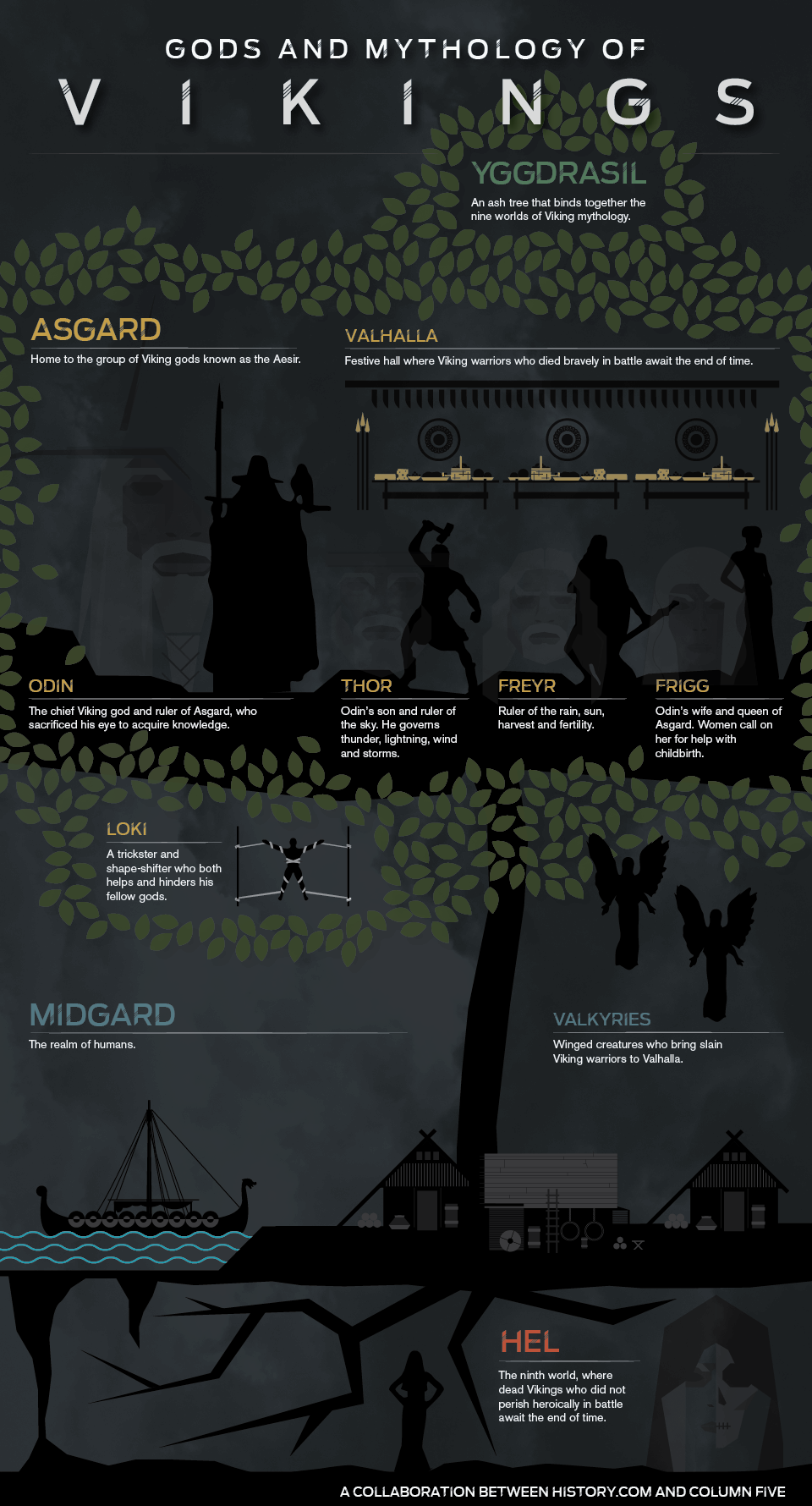
Gods and Mythology of the Vikings - History.com and Column Five
Grades
6 to 12tag(s): myths and legends (44), vikings (11)
In the Classroom
Use this infographic in conjunction with a study of Viking Mythology. Divide the students into small groups to investigate the different terms mentioned on the infographic. Have the students present their findings to the class by creating a multimedia presentation using one of the many TeachersFirst Edge tools, reviewed here. You might consider having students use Nordic Gods, reviewed here, to gather some basic information about the gods, Asgaard, etc.Add your comments below (available only to members) | Become a Member
You must be registered and logged in to add items to your favorites.
Use the form at the top of the page to log in, or click here to join TeachersFirst (it's free!).
Nordic Gods - Jo Edkins
Grades
6 to 12tag(s): myths and legends (44), vikings (11)
In the Classroom
Include this site when studying Nordic or Viking mythology. Have a link to this site on your class web page for students to use at home. You might also like to share the infographic Gods and Mythology of Vikings, reviewed here. Divide students into small groups to investigate the gods and where they lived. Have them present their findings to the class by creating a multimedia presentation using one of the many TeachersFirst Edge tools, reviewed here. You might consider having students use Fakebook, reviewed here. Have them create a "fake" page similar in style to Facebook from the perspective of any of the gods. Ask students to create a short story involving one or more of the gods and using the Old Norse names for other characters in their story. You might suggest the definition of the name indicate what that character is about.Add your comments below (available only to members) | Become a Member
You must be registered and logged in to add items to your favorites.
Use the form at the top of the page to log in, or click here to join TeachersFirst (it's free!).
Egyptian Gods - Jo Edkins
Grades
4 to 12tag(s): egypt (60), myths and legends (44)
In the Classroom
Use this site as a starting point to learn about Egyptian Gods for world history and ancient religions classes. It is also an excellent introduction to a unit on Egypt for young learners. Put a link to this site on a classroom computer as an activity center for the Egyptian unit of study. Assign student pairs or small groups a god and to research the myths about that god. Students could create a class book retelling a favorite myth for each god using Creative Common images to illustrate the myth. To find Creative Commons images for student projects (with credit, of course), try Wikimedia Commons, reviewed here. Images and myths can be completed in Classroom Authors, reviewed here, for actual book production. Be sure to include this site on your class web page for students to access both in and outside of class.Add your comments below (available only to members) | Become a Member
You must be registered and logged in to add items to your favorites.
Use the form at the top of the page to log in, or click here to join TeachersFirst (it's free!).
Ducksters - Technological Solutions, Inc. (TSI)
Grades
2 to 8This site includes advertising.
tag(s): addition (136), african american (130), american revolution (99), animal homes (55), animals (281), artists (106), biographies (102), china (79), civics (138), civil rights (228), civil war (148), cold war (40), continents (30), countries (67), data (214), division (108), egypt (60), elements (31), energy (136), environment (245), explorers (65), fractions (173), friction (14), geometric shapes (150), greece (47), habitats (113), human body (97), inventors and inventions (87), keyboarding (28), mean (18), median (16), mode (12), multiplication (131), planets (122), presidents (153), puzzles (178), recycling (47), renaissance (36), rome (38), solar system (126), sound (71), sports (106), subtraction (115), sun (87), world war 1 (88), world war 2 (169)
In the Classroom
This site is a perfect addition for use with a biography unit. Explore and share information categorized by topics such as Civil Rights, the Cold War, Ancient Greece, and WWII. Extend student learning by having students use Fakebook, reviewed here, to create a "fake" page similar in style to Facebook about a president, famous scientist, or nearly any other real or fictitious person. Be sure to create a link to the site on your class webpage or newsletter for students to explore at home. Create a link on classroom computers for students to use the interactives during center time.Comments
Very safe and reliable. Everyone else is my school thinks ducksters is stupid but I love ducksters.Ry, CA, Grades: 6 - 12
Add your comments below (available only to members) | Become a Member
You must be registered and logged in to add items to your favorites.
Use the form at the top of the page to log in, or click here to join TeachersFirst (it's free!).
Myths: Writing Workshop with Jane Yolan - Scholastic Inc
Grades
K to 12This site includes advertising.
tag(s): digital storytelling (182), egypt (60), enrichment (20), greece (47), myths and legends (44)
In the Classroom
After you choose your level, discover one or many of the lessons to integrate into your English Language Arts or Social Studies curriculum. Choose your objectives, and find the lessons that are appropriate. Some lessons can be shared on the interactive whiteboard or projector. Others are more appropriate alone as individual work. Materials are included so much of the prep work is already done for you. To conclude the myths unit, have students create a play featuring a unique culture and a hero they create. Students will need a detailed script containing; theme, plot, settings, and characters including a hero. Go as far as you want developing props, costumes, and accompanying sounds and music. Have students present using a live presentation, video, or digital storytelling. Choose from the TeachersFirst Digital Storytelling tools, reviewed here. This site is a great reference for an after-school enrichment program on writing, reading, book clubs, or even self esteem.Add your comments below (available only to members) | Become a Member
You must be registered and logged in to add items to your favorites.
Use the form at the top of the page to log in, or click here to join TeachersFirst (it's free!).
Roman Gods - Jo Edkins
Grades
4 to 12tag(s): myths and legends (44), romans (54)
In the Classroom
Use this site as a reference for students studying world history and ancient religions. It is also an excellent introduction to a unit on the Romans for young learners. Put a link to this site on a classroom computer as an activity center for the Roman unit of study. Assign student pairs, or small groups, a topic (god or myths about that god). Have students create a multimedia presentation using Presentious, reviewed here. This tool allows narrating and adding text to a picture. Challenge students to find a Creative Commons photo or image, and then narrate the photo as if it is a news report about the god's life. To find Creative Commons images for student projects (with credit, of course), try Stockio, reviewed here.Add your comments below (available only to members) | Become a Member
You must be registered and logged in to add items to your favorites.
Use the form at the top of the page to log in, or click here to join TeachersFirst (it's free!).
History on the Net - Heather Wheeler
Grades
7 to 12This site includes advertising.
tag(s): african american (130), aztecs (10), battles (19), black history (133), britain (24), civil rights (228), cold war (40), egypt (60), elizabethan (12), greeks (45), mayans (31), myths and legends (44), native americans (169), olympics (64), romans (54), victorian (16), vikings (11), worksheets (72), world war 1 (88), world war 2 (169)
In the Classroom
Use this site as an anticipatory set or "activator" to introduce a unit or lesson on a projector or interactive whiteboard. Make a shortcut to this site on classroom computers and use it as a center. Use this site as the starting point for individual or group projects. This site is a perfect addition to use with President's Day activities, when learning about the Olympics, or as part of a Black History Month lesson. Be sure to include this site on your class web page for students to access both in and outside of class. Enhance students' learning by having them use Fakebook, reviewed here, to create a "fake" page similar in style to Facebook about a president, a passenger on the Titanic, a famous scientist, or another person learned about on this site. Have students modify their learning by creating an interactive, multimedia infographic sharing their findings using Venngage, reviewed here.Add your comments below (available only to members) | Become a Member
You must be registered and logged in to add items to your favorites.
Use the form at the top of the page to log in, or click here to join TeachersFirst (it's free!).
Make A Roman Mosaic - Jo Edkins
Grades
3 to 12In the Classroom
Demonstrate how to use this tool on your projector or interactive whiteboard. Share this tool during art class to incorporate art into history lessons. Have students create their own designs and practice patterns. Create a Roman Mosaic to incorporate into classroom reports. Use this tool in math class when teaching about symmetry. In geometry class challenge students to create shapes using this tool.Add your comments below (available only to members) | Become a Member
You must be registered and logged in to add items to your favorites.
Use the form at the top of the page to log in, or click here to join TeachersFirst (it's free!).
Cool Kid Facts - CoolKidFacts
Grades
1 to 7This site includes advertising.
tag(s): animals (281), australia (27), brain (59), china (79), deserts (20), earth (187), egypt (60), greek (46), heart (26), human body (97), italy (30), magnetism (40), mars (25), mexico (67), moon (87), newton (25), photosynthesis (18), rainforests (16), rome (38), sun (87), tornadoes (17), tsunamis (15), volcanoes (60)
In the Classroom
Share this site with students on your interactive whiteboard (or projector) and show them all the different subjects available. Challenge students to find a topic about which they know nothing (or barely anything). This site will give them experience reading informational text on a topic they wonder about. Partner weaker readers with others who may be able to help them read the text-heavier articles. Have students read and research individually or in small groups taking notes using a simple graphic organizer from Holt Interactive Graphic Organizers, reviewed here. Use this opportunity to teach summarizing, and citing sources. Cool Kid Facts is a great tool to build background knowledge about all sorts of topics!Add your comments below (available only to members) | Become a Member
You must be registered and logged in to add items to your favorites.
Use the form at the top of the page to log in, or click here to join TeachersFirst (it's free!).
Stuff You Missed in History Class - Tracy Wilson and Holly Frey
Grades
7 to 12This site includes advertising.
tag(s): archeology (26), black history (133), civil rights (228), civil war (148), cross cultural understanding (167), mental health (63), native americans (169), podcasts (188), religions (120), vikings (11), world war 1 (88), world war 2 (169)
In the Classroom
Use podcasts from Stuff You Missed in History to enrich current lessons or lure students into thinking history can actually be "cool." Provide a link on class computers or your class website for students use. Have students use a mapping tool such as Zeemaps, reviewed here, to create a map of one of these events (with audio stories and pictures included)! Have students use Fakebook, reviewed here, to create a "fake" page similar in style to Facebook about one of the people in these lesser known historic events.Add your comments below (available only to members) | Become a Member
You must be registered and logged in to add items to your favorites.
Use the form at the top of the page to log in, or click here to join TeachersFirst (it's free!).
ORBIS: The Stanford Geospatial Network Model of the Roman World - Stanford University
Grades
7 to 12tag(s): maps (222), romans (54), rome (38), transportation (31)
In the Classroom
There are a lot of complexities involved in plotting a route between two cities, but the interface is pretty intuitive, and students with enjoy playing "what if" with the various possibilities. Once they get the hang of it, challenge individual students or groups to see who can make it from start to finish most quickly or cheaply. What happens if you start in the Winter? or the Fall? And of course, how did these challenges affect the real Roman Empire and its citizens? If individual computers aren't available, plot your travel as a class on your interactive whiteboard or projector. Include this in Latin or world history class to make Roman civilization more "real."Add your comments below (available only to members) | Become a Member
You must be registered and logged in to add items to your favorites.
Use the form at the top of the page to log in, or click here to join TeachersFirst (it's free!).
Discovering Ancient Egypt - Mark Millmore
Grades
4 to 9This site includes advertising.
In the Classroom
The videos and information from this site would be useful during any unit on Ancient Egypt. Math teachers will also love the information about Egyptian numbers to include in a unit on different number systems. Share videos on an interactive whiteboard (or projector). Create a link on classroom computers for students to explore on their own. Have students create messages using the hieroglyphic typewriter then print (or screenshot) for others to decode. Have students create interactive timelines using information from this site using Sutori, reviewed here. Sutori can include images, text, and collaboration.Add your comments below (available only to members) | Become a Member
You must be registered and logged in to add items to your favorites.
Use the form at the top of the page to log in, or click here to join TeachersFirst (it's free!).
Giza 3D - Dassault Systemes
Grades
6 to 12tag(s): architecture (81), egypt (60), pyramids (24)
In the Classroom
View this site in the classroom using a projector or interactive whiteboard. View the reconstruction of these artifacts from information collected during its discovery. Use the 3D tour to view the Necropolis, join a guided tour of the monuments, and look at the collected objects reconstructed from the site. Bring the history of Egypt to life. This is a powerful tool to show the role of Archaeology in reconstructing history. Compare this site to the work of archaeologists at Jamestown or other historic locations to talk about different techniques of science used to reveal history.Add your comments below (available only to members) | Become a Member
You must be registered and logged in to add items to your favorites.
Use the form at the top of the page to log in, or click here to join TeachersFirst (it's free!).
Engaging Students With Primary Sources - Smithsonian National Museum of American History
Grades
6 to 12tag(s): primary sources (177)
In the Classroom
Bookmark and save this site for use throughout the year as a guide for using primary sources. Use some of the lesson strategies with other primary source collectionsAdd your comments below (available only to members) | Become a Member
You must be registered and logged in to add items to your favorites.
Use the form at the top of the page to log in, or click here to join TeachersFirst (it's free!).
Saylor - Free Online Courses Built by Professors - Michael J Saylor
Grades
7 to 12tag(s): professional development (307)
In the Classroom
Allow gifted students to enroll in courses that interest them or that provide enrichment beyond classroom content. Share with others in your building as a resource for professional development. Explore the topics yourself for some new, engaging topics to round out your own expertise. Allow students to enroll in a course that would fit into their career goals as an exploratory opportunity in that field.Add your comments below (available only to members) | Become a Member
You must be registered and logged in to add items to your favorites.
Use the form at the top of the page to log in, or click here to join TeachersFirst (it's free!).
Add your comments below (available only to members) | Become a Member
Close comment form